
Updated COVID-19 booster eligibility expanded to people ages 5 and older

The Washington State Department of Health (DOH) and other healthcare providers will soon begin offering Omicron variant-targeted bivalent booster doses of COVID-19 vaccines to people ages 5 and older, following guidance and recommendations from the U.S. Food and Drug Administration (FDA), the Centers for Disease Control and Prevention (CDC), and the Western States Scientific Safety Review Workgroup.

“This is another step forward to a healthier tomorrow for everyone in Washington state,” said Umair A. Shah, MD, MPH, Secretary of Health. “The more people who are eligible for COVID-19 boosters, the better protection we can provide to our communities.

This new demographic of booster eligibility expansion follows last month’s rollout of the updated (bivalent) COVID-19 vaccine, which specifically targets the BA.4 and BA.5 subvariants that currently make up the majority of COVID-19 cases across the country. The Department of Health urges all individuals 5 and older to prioritize receiving the updated booster as we enter the beginning of cold and flu season. Additionally, flu vaccines are now available at many provider offices and pharmacies across the state and are safe to receive concurrently with the COVID-19 bivalent booster.

“It’s also time to get your flu shot,” Dr. Shah added. “We are entering respiratory illness seasons and it is a critical time to protect yourself and those around you from influenza.”

DOH’s updated COVID-19 booster dose recommendations are as follows:

  • People ages 5 and older who have completed a primary vaccine can receive the Pfizer-BioNTech bivalent booster at least two months after their most recent dose. These doses are scheduled to begin arriving in provider offices the week of October 17th.
  • People ages 6 and older who have completed a primary vaccine series can receive the Moderna bivalent booster at least two months after their most recent dose. Providers who already have an inventory of Moderna can begin administering these doses immediately.
  • Children ages 6 months to 4 years remain eligible for the primary, monovalent COVID-19 vaccine series from both Pfizer-BioNTech and Moderna and are not currently authorized for any COVID-19 booster doses.

As with previous vaccine and booster rollouts, the CDC will provide states with weekly allocations, building each state’s inventory levels over time. DOH urges the public to remain patient as we expect initial demand to exceed availability, resolving in the following weeks.

To make a vaccine or booster appointment, visit VaccinateWA.org, or call the COVID-19 Information Hotline at 833-VAX-HELP. Language assistance is available. Those individuals with further questions are encouraged to visit DOH’s COVID-19 Vaccine Frequently Asked Questions webpage or talk to their trusted healthcare provider.
Will Covid Spike Again This Fall? 6 Tips to Help You Stay Safe

Last year, the emergence of the highly transmissible omicron variant of the covid-19 virus caught many people by surprise and led to a surge in cases that overwhelmed hospitals and drove up fatalities. Now we’re learning that omicron is mutating to better evade the immune system.

Omicron-specific vaccines were authorized by the FDA in August and are recommended by U.S. health officials for anyone 5 or older. Yet only half of adults in the United States have heard much about these booster shots, according to a recent KFF poll, and only a third say they’ve gotten one or plan to get one as soon as possible. In 2020 and 2021, covid cases spiked in the U.S. between November and February.

Although we don’t know for sure that we’ll see another surge this winter, here’s what you should know about covid and the updated boosters to prepare.

1. Do I need a covid booster shot this fall?

If you’ve completed a primary vaccination series and are 50 or older, or if your immune system is compromised, get a covid booster shot as soon as possible. Forty percent of deaths are occurring among people 85 and older and almost 90% among people 65 and over. Although people of all ages are being hospitalized from covid, those hospitalizations are also skewing older.

Unvaccinated people, while in the minority in the U.S., are still at the highest risk of dying from covid. It’s not too late to get vaccinated ahead of this winter season. The United Kingdom, whose covid waves have presaged those in the United States by about a month, is beginning to see another increase in cases.

If you’ve already received three or more covid shots, you’re 12 to 49 years old, and you’re not immunocompromised, your risk of hospitalization and death from the disease is significantly reduced and additional boosters are not likely to add much protection.

However, getting a booster shot provides a “honeymoon” period for a couple of months after vaccination, during which you’re less likely to get infected and thus less likely to transmit the virus to others. If you’ll be seeing older, immunocompromised, or otherwise vulnerable family and friends over the winter holidays, you might want to get a booster two to four weeks in advance to better shield them against covid.

You may have other reasons for wanting to avoid infection, like not wanting to have to stay home from work because you or your child is sick with covid. Even if you aren’t hospitalized from covid, it can be costly to lose wages or arrange for backup child care.

One major caveat to these recommendations: You should wait four to six months after your last covid infection or vaccination before getting another shot. A dose administered too soon will be less effective because antibodies from the previous infection or vaccination will still be circulating in your blood and will prevent your immune cells from seeing and responding to vaccination.

Read the full article from KHN.

Public health experts recommend the flu and COVID-19 vaccines for everyone age 6 months and older

The Washington State Department of Health (DOH) is urging the public to get an influenza (flu) vaccine in addition to a COVID-19 booster this fall to keep themselves and others safe and out of the hospital.

In recent years flu activity was low due to the preventive benefits of social distancing, masking, and other COVID-19 precautions. Now that guidance and recommendations have relaxed, people are more active, mobile, and have returned to traditional gatherings. At the tail of the last flu season, Washington experienced an unusual late spring wave of flu.

With the start of fall, many adults have returned to in-person work and most children are back in school. These conditions could lead to an increase in flu or COVID-19 cases this fall or winter.

“Flu can be unpredictable and sometimes severe,” said Tao Sheng Kwan-Gett, MD, MPH, Chief Science Officer. “To protect your family’s health, getting vaccinated against influenza with a flu shot or nasal spray vaccine should be part of the fall routine for everyone 6 months and older. It’s also the perfect time to get up to date on COVID-19 vaccines and boosters too.”

Young children, pregnant people, those with underlying health conditions, and people aged 65 and older are at high risk for flu-related complications. The flu is a highly contagious disease that can cause severe illness and lead to hospitalization and death – even in healthy, young people. Getting a flu vaccine reduces the chance of flu illness and protects individuals from serious flu symptoms. The flu shot can be safely given at the same time as a COVID-19 vaccine or booster.

Flu illness is more dangerous than the common cold for children, especially for children under 5 years old. Flu can be deadly in young children. About 80% of flu-related deaths in children are in those who were not vaccinated. Across Washington, the flu vaccine, and all recommended childhood vaccines, are available at no cost for everyone age 18 years and younger.

For weekly flu activity reports, educational materials, vaccine information, and other flu prevention resources, visit www.KnockOutFlu.org. For more information on COVID-19 vaccines, visit the COVID-19 website.

New KFF/CNN Survey on Mental Health Finds Young Adults in Crisis

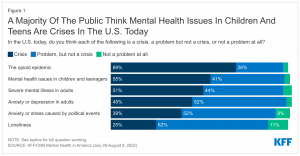
An overwhelmingly majority (90%) of Americans believe the nation is in the midst of a mental health crisis, and young adults appear to be suffering the most, a new KFF-CNN survey on mental health in America reveals.

A third (34%) of adults under age 30 rate their mental health as “only fair” or “poor,” compared to 19% of those ages 30 and older. Half (52%) say they “always” or “often” felt anxious over the past year (28% for older adults), and about a third say they always or often felt depressed (33%) or lonely (32%) in the past year, also significantly higher than for older adults (18% each among those ages 30 and older).

In addition, about a third (35%) of young adults say they have been unable to work or engage in other activities due to a mental health condition in the past year, a rate significantly higher than older adults.

Read the full article from KFF.

Medicaid’s Essential Role in Improving the Mental Health of America’s Most Vulnerable Youth

Since well before the COVID-19 pandemic began, the number of young people diagnosed with a mental health need has been increasing, particularly among ethnic minorities, low-income households, and those involved with the child welfare and juvenile justice systems. In response, there has been an increased focus over the past year on strengthening behavioral health services for children and adolescents. A recent report from the Surgeon General describes “a national emergency in child and adolescent mental health” and offers several recommendations, including expanding access to response teams and funding community-based care systems to connect families with evidence-based interventions in their homes, communities, and schools.

Prevention and screening are also essential to meet the needs of young people at risk of mental health challenges. Fortunately, in 2013, the Centers for Medicare and Medicaid Services (CMS) issued guidance outlining the need to provide mental health and substance use treatment to members under age 21, including behavioral health screening and preventive services. Medicaid, which covers approximately 27 million young people, addresses this priority by offering the Early and Periodic Screening, Diagnostic, and Treatment (EPSDT) benefit, which requires states to provide medically necessary services to people under 21 who may be experiencing a mental health need. EPSDT is more comprehensive than commercial insurance benefits, ensuring access to physical and mental health care that promote healthy development and to treatment that addresses symptoms before they worsen. This is a powerful tool; Medicaid-eligible youth are entitled to EPSDT benefits regardless of whether the service is covered in their state’s Medicaid program.

The recent launch of the national 988 suicide and crisis hotline has spotlighted efforts to ensure the availability of behavioral health mobile crisis teams. But preventive services and behavioral health screening can prevent youth from requiring an intervention in the first place. The Center for Medicaid and CHIP Services estimates that 11 percent of youth have a mental health diagnosis, and that at least two-thirds of those youth were not identified as receiving any mental health service. Attending to the wellness of caregivers is also part of ensuring healthy children and strong attachment with caregivers. In 2016, CMS issued guidance allowing for maternal depression screens as part of the EPSDT benefit. A 2018 survey found 31 states and Washington, D.C., allow maternal depression screening to be billed under the child’s Medicaid.

Read the full article from the Commonwealth Fund.

COVID-19 Boosters

The CDC recently recommended the following updated mRNA COVID-19 vaccine boosters to help restore protection that has waned since previous vaccination and target more transmissible and immune-evading variants:

  • The Moderna bivalent mRNA COVID-19 booster is authorized for people 18 and older.
  • The Pfizer bivalent mRNA COVID-19 booster is authorized for people 12 years and up.

These boosters are referred to as “bivalent” vaccines because they target both the original strain of COVID-19 and the Omicron BA.4 and BA.5 subvariants currently circulating in the United States. These updated boosters will help better protect us against these and future variants that might be closely related to Omicron.

Everyone who is eligible to receive the bivalent booster – including those who are moderately and severely immunocompromised – are recommended to receive ONE dose of the booster regardless of how many doses they have received previously. Those eligible may receive the updated booster if at least 2 months have passed since their last COVID-19 dose (either the final primary series dose or the last booster).

The original (monovalent) mRNA COVID-19 vaccine boosters are no longer authorized for people aged 12 years and older and can no longer be given to them, even if they had not previously received a monovalent booster dose. Children ages 5-11 should still receive the monovalent booster (at least 5 months after their second dose).

Routine Childhood Immunizations, Seasonal Influenza, & COVID-19 Vaccination can be co-administered

COVID-19 disrupted both in-person learning and routine well-child visits for many children. As a result, tens of thousands of children and adolescents have fallen behind on receiving recommended vaccines.

Timely vaccination is critical, as immunization schedules are designed to provide children with immunity early in life before they may be exposed to life-threatening diseases. Not only do delayed or missed vaccines leave children vulnerable to illness but when vaccination rates fall even just a little, vaccine-preventable diseases can spread easily.

We know from studies conducted throughout the pandemic that receiving a COVID-19 vaccine at the same time as routine immunizations is safe. If multiple vaccines are due, giving more than one vaccine at the same visit is important because it increases the probability that an individual will be up to date with vaccines.

In addition, with both influenza and COVID-19 viruses circulating, getting both the Flu and COVID-19 vaccines is important for prevention of severe disease, hospitalization, and death. CDC recommends health care providers offer influenza and COVID-19 vaccines at the same visit, with each dose administered in separate limbs.

Blood Donations Urgently Needed

The back-to-school season is a critical time for our blood supply

As summer ends and the school year begins, the Washington State Department of Health (DOH) and Northwest Blood Coalition urge eligible blood donors to schedule donations.

According to the Northwest Blood Coalition, high school and college students make up almost 25 percent of blood donations. “High schoolers and college-age youth are critically important members of our donor base,” shared Vitalant Regional Director Jennifer Hawkins.

The Northwest Blood Coalition is formed by four blood donation centers currently serving Washington state: Vitalant, Cascade Regional Blood Centers, BloodworksNW, and the American Red Cross Northwest Region. As Red Cross Regional Services Executive Angel Montes describes, “The Northwest Blood Coalition’s primary focus is to ensure a safe, reliable blood supply for our community.” DOH collaborates with the coalition to support this vital work.

“Blood centers enthusiastically welcome students back to school,” said Curt Bailey, President and CEO at BloodworksNW. “We want to engage those interested in the rewarding, lifesaving act of donating blood—whether they’ve done it before or it’s their first time.”

Every two seconds, someone in the U.S. needs blood. Donated blood is crucial for those undergoing surgeries, cancer treatments, blood disorder treatments, complications from childbirth, and other serious conditions and injuries. However, blood supply shortages continue to be a nationwide concern, and Washington state is no exception.

“We know that people want to help. Donations tend to slow when school is on break and summer activities are happening,” added Christine Swinehart, President and CEO at Cascade Regional Blood Centers. “As we look toward fall, we want to remind folks that now is a great time to donate!”

To learn more and schedule an appointment, please visit the blood center websites linked above.

Department of Homeland Security Finalizes “Public Charge” Immigration Rule

The Department of Homeland Security (DHS) has finalized a rule defining the criteria it uses when determining whether a person can be denied a visa and/or legal residency because they are likely to become a “public charge.” The final rule comes on the heels of the proposed rule, published February 24, 2022, and is the latest chapter in a long series of regulatory and legal actions surrounding the public charge policy. It includes several provisions that directly affect older immigrants and immigrants with disabilities, their families and caregivers.

For more information and background on the history of the public charge policy, see ACL’s March 2022 blog post on the Notice of Proposed Rulemaking and the July 2021 blog post on the history of public charge rulemaking as well as resources from the Department of Homeland Security.

What’s most important for older immigrants and immigrants with disabilities to know?

Someone may be considered a “public charge” if they are likely to become primarily dependent on the government for subsistence. This is evaluated by looking at prior and current use of certain public benefits as well as other factors such as age, health, and financial resources.

Participation in most public benefits, including ACL’s programs, will not adversely impact a citizenship or residency determination under the new rule. The ONLY public benefits considered in a public charge determination are:

  • Long-term institutionalization funded by the government (for example, Medicaid-financed care in a nursing facility). Receiving Medicaid Home and Community-Based Services (HCBS) or other Medicaid health care benefits will not affect a public charge determination.
  • Direct cash assistance programs, including Supplemental Security Income (SSI) and Temporary Assistance for Needy Families (TANF).

This is a codification of DHS’ 1999 Field Guidance (the policy that is currently in place). It solidifies DHS’ long-standing position on which public benefits will be considered in a public charge determination and which will not.

What are the major provisions of the final rule?

DHS received 233 comments on the proposed rule, including many from the aging and disability community. The final rule provides responses to many of those comments, explaining why policy changed or remained the same. The final rule closely mirrors the proposed rule with a few exceptions. The major provisions include:

  • Receiving Medicaid Home and Community Based Services (HCBS) will not factor into any public charge determination. Medicaid HCBS, as well as acute care benefits, will not be considered.
  • Long-term institutionalization at government expense will be factored into a public charge determination and while “long-term” is not explicitly defined, the rule includes guardrails. While the rule did not define what constituted “long-term” institutionalization with a hard threshold or day limit, it did specify that short-term residential care for rehabilitation or mental health treatment would not be considered. Long-term institutionalization also does not include imprisonment for conviction of a crime. DHS will collaborate with the Department of Health and Human Services to develop sub-regulatory guidance to help guide DHS agents’ evaluation of past or current institutional stays.
  • Evidence may be presented to show unjustified institutionalization in violation of federal law. DHS recognizes that some people are forced to live in institutions due to the unavailability of HCBS and in violation of their rights under the Americans with Disabilities Act and Section 504 of the Rehabilitation Act (as interpreted by the Supreme Court in Olmstead v. L.C.). As a result, an applicant for admission to the United States or an immigration status change may present evidence to show their institutionalization was in violation of federal law, thus mitigating negative weight that may be put on that period of institutionalization during a public charge determination.
  • No single factor alone is determinative of whether someone may be deemed a “public charge.” DHS will perform a “totality of the circumstances test” considering both past and current use of publicly funded institutional care and cash assistance. The test also includes an evaluation of five statutory factors: health, age, family status, assets/resources/financial status, education/skills to determine likelihood of primary dependence on the government for support. No single factor is determinative, however. Thus, past or current institutionalization, receipt of cash benefits, poor health or advanced age alone is not sufficient to render someone a public charge.
  • Disability alone is not sufficient for a determination that individual is likely to become a public charge. Disability, as defined in Sec. 504 of the Rehabilitation Act of 1973, cannot be the sole basis for a determination that an that individual is in poor health, is likely to require long-term institutionalization at government expense, or is likely to become a public charge due to any other factor.
  • DHS will consider the medical evaluation performed by a physician when evaluating a non-citizens health: In the proposed rule, DHS did not specify evidence it would consider as a part of the statutory minimum factor evaluation. In the final rule, DHS clarifies it will accept information submitted via forms it is already gathering as a part of the admission, citizenship, or naturalization process. The standard medical report and vaccination record  will be considered as evidence for the health factor. This report captures information on a non-citizens chronic health conditions and/or disabilities and will be used by DHS agents in the “totality of the circumstances” analysis. DHS will work with HHS on guidance to agents to ensure disability competency when evaluating medical conditions or disabilities that appear on the medical report.

What does this mean for immigrant communities moving forward?

Non-citizens should apply for and use the public benefits to which they are entitled, with the understanding that:

  • Long-term institutionalization paid for by Medicaid (or another public source) or cash benefits like SSI or TANF may, but will not necessarily, adversely affect immigration decisions under the public charge rule.
  • Using other services – such as Medicaid HCBS, services provided through ACL’s programs, or the Supplemental Nutrition Assistance Program (SNAP) – will not affect immigration decisions under the public charge rule.

The final rule will be effective on December 23, 2022, and will be published in the Federal Register on September 9, 2022.

Read more:

Release from the U.S. Department of Health and Human Services: New Rule Makes Clear that Noncitizens Who Receive Health or Other Benefits to which they are Entitled Will Not Suffer Harmful Immigration

Omicron COVID-19 vaccine boosters now authorized for certain individuals

The Washington State Department of Health (DOH) and other healthcare providers will soon begin offering Omicron variant-targeted bivalent booster doses of the Pfizer-BioNTech and Moderna COVID-19 vaccines following authorization by the U.S. Food and Drug Administration (FDA), and recommendations from the Centers for Disease Control and Prevention’s Advisory Committee on Immunizations Practices, and the Western States Scientific Safety Review Workgroup.  

The bivalent vaccines combine the companies’ original COVID-19 vaccine compositions with BA.4 and BA.5 spike protein components, providing additional protection by targeting variants that are more transmissible and immune-evading. The primary COVID-19 vaccine series will stay the same, given their proven efficacy in preventing serious illness, hospitalization, and death from COVID-19. DOH’s updated booster dose recommendations are as follows: 

  • People ages 12 – 17 who have completed a primary vaccine series can receive the Pfizer-BioNTech bivalent booster at least two months after their most recent dose. 
  • People 18 and older who have completed a primary vaccine series can receive either company’s bivalent booster at least two months after their most recent dose. 
  • Those ages 5 – 11 who have completed Pfizer-BioNTech’s primary vaccine series should continue to receive the company’s original monovalent booster at least 5 months after their most recent dose. 
  • Children ages 6 months – 4 years are currently not authorized for any COVID-19 booster doses. 
  • People ages 12 and over who currently have appointments to receive COVID-19 booster doses will need to contact their providers to ensure the bivalent booster is available; if not, those appointments will need to be rescheduled, as the former monovalent booster doses are no longer authorized for this age group. 

“We’re excited this updated bivalent booster will help increase protection against the Omicron variants as we head into the fall season,” said Tao Sheng Kwan-Gett, MD, MPH, Chief Science Officer. “As SARS-CoV-2 changes, so must the tools we use against it – this update helps ensure that vaccines and boosters will continue to be the most effective ways to reduce the risk of hospitalization and death, and keep those most at-risk healthy and safe.” 

An initial allocation of 191,100 bivalent booster doses is currently en route to providers throughout the state and will be available beginning the week of September 5 after the Labor Day holiday. Subsequent weekly allocations will follow, building the state’s inventory levels over time. DOH urges the public to remain patient, as we expect initial demand to exceed available inventory before resolving in the coming weeks, and to visit Vaccine Locator or call the COVID-19 Information Hotline at 1-800-525-0127 to find available resources near them. 

Be safe this Labor Day weekend and National Preparedness Month

As we head into Labor Day weekend, the Washington State Department of Health (DOH) encourages everyone to keep health and safety in mind.

For many, Labor Day weekend is not only a celebration of our workforce and labor movement. It’s also an opportunity to gather and enjoy the summer season as it draws to a close.

“We want people in Washington to have fun this holiday weekend, and to do so as safely as possible,” said Nathan Weed, Chief of Resilience. “Whether having a barbecue, celebrating on the water, or joining other activities, a little planning and awareness can go a long way in preventing an illness or accident.”

Here are some easy—yet impactful—ways to prepare for a safe, healthy holiday:

September is also National Preparedness Month. Public health agencies use this annual observance to promote emergency preparedness and encourage community members to take action before, during, and after an emergency. From an infectious disease outbreak to a natural disaster, DOH is ready to respond to help address and maintain the safety of Washingtonians.

Watch for additional preparedness tips and guidance through the month of September on the DOH website and social media.